
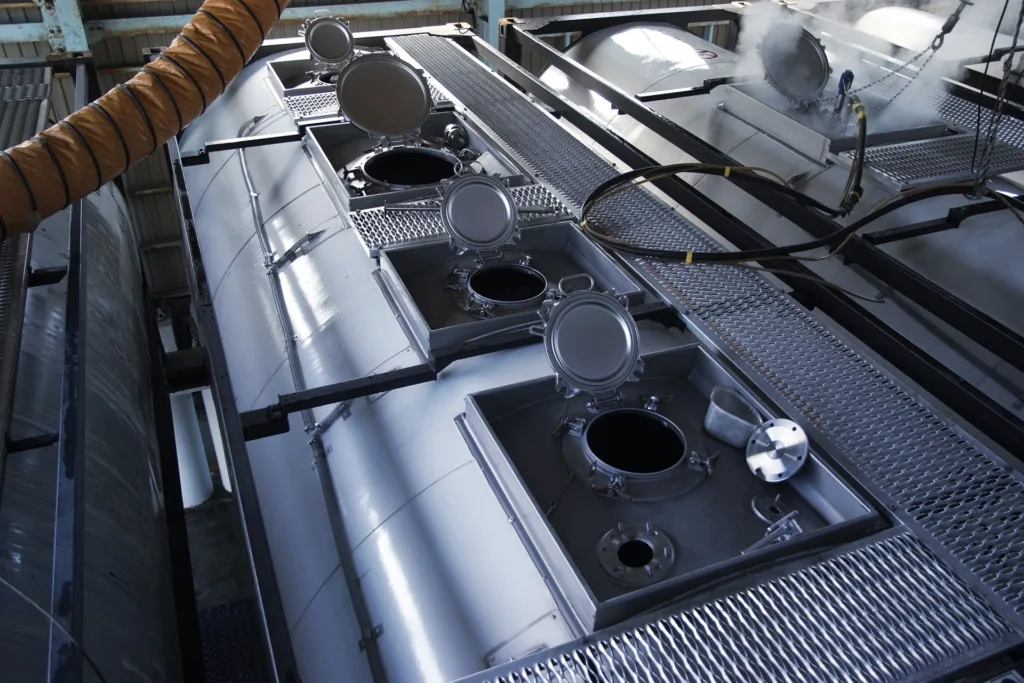
Why Interior Tank Cleaning Is Critical for Safe Bulk Liquid Transport
Interior tank cleaning determines whether the next load arrives safely, whether a carrier remains compliant with federal regulations, and how effectively both parties can document their practices when issues arise.
Inadequate cleaning can result in product loss, load rejection, regulatory penalties, and significant liability exposure. For shippers evaluating carriers and logistics managers establishing operational standards, understanding proper cleaning requirements is essential for making informed decisions before problems occur.
How Residual Product Buildup Creates Contamination and Safety Risks
Depending on the substances involved, residual product left inside a cargo tank can react with incoming loads, alter physical properties, or create conditions that foster microbial growth.
Chemical residues pose risks such as off-gassing, viscosity changes, and pH shifts upon contact with incompatible products. Even trace amounts can compromise product integrity, often going unnoticed until the receiving facility conducts quality testing.
Food-grade liquid transport presents unique challenges, as even FDA-approved ingredients can contaminate subsequent loads if not completely removed. For instance, residual traces of a single flavoring can ruin an entire batch of another product. Furthermore, residual moisture increases risk by encouraging bacterial growth in tanks that appear visually clean.
When Prior Load History Creates Risk
The FDA’s 2010 guidance on sanitary transportation of food highlights “backhauling hazardous materials” and failing to maintain wash records as major contamination risks. Without a complete and accurate load history, carriers cannot certify that a tank is suitable for its next cargo.
In addition, residue accumulates over time in hard-to-reach areas. Valve seats, hose connections, and fittings are common collection points that simple surface rinses fail to clean thoroughly.
Interior Cleaning Procedures for Chemical and Food-Grade Tanks
Interior cargo tank cleaning procedures vary significantly between chemical and food-grade operations. Neither application allows for a one-size-fits-all solution, and these distinctions are critical for certification, recordkeeping, and regulatory compliance.
Cleaning chemical tanks requires solvent rinses, neutralizing agents, and purging cycles tailored to the prior product’s hazard classification and compatibility with the upcoming load. Because no single protocol applies to every chemical shipment, detailed, written, product-specific procedures are mandatory.
Food-grade tank cleaning is subject to stricter regulation. Protocols typically involve a hot-water pre-rinse, a wash cycle maintained between 160 and 185 degrees Fahrenheit, and, when required, a sanitizing rinse. No cleaning agents may remain once the process is complete. Before a wash is certified, technicians must conduct a comprehensive interior inspection of all fittings, valves, hose connections, and the tank shell, documenting the entire process on a wash certificate.
The Role of Heat and Pre-Cleaning Preparation
Viscous products harden as they cool, meaning tanks that carried heated cargo cannot simply be rinsed at ambient temperature. In these cases, preheating ensures complete drainage before the wash cycle begins. Steam boilers supply the heat required to preheat tanks and maintain precise wash-water temperatures throughout the cleaning cycle.
Tanks carrying vapor hazard loads demand specialized preparation and must be purged before personnel entry is permitted. OSHA 29 CFR 1910.146, governing permit-required confined spaces, defines the safety standards required for these entry operations.
Wash Rack Standards and Certified Cleaning Facilities
Carriers must utilize certified wash racks equipped for the specific materials they transport. Proper facility certification directly impacts the validity of wash certificates and a carrier’s ability to demonstrate compliance to shippers and regulatory authorities.
According to Bulk Transporter, poor communication between carriers and cleaning facilities is a leading cause of contamination. Facilities require accurate load histories and Safety Data Sheets (SDS) to execute the correct cleaning protocol. Food-grade wash certificates must accurately record the date, time, previous load, procedure used, water temperature, and wash duration. Missing or inaccurate records create compliance gaps under FDA regulations that cannot be resolved retroactively.
Cleaning Frequency Requirements Based on Product Type
No single cleaning schedule applies to all bulk liquid transport operations. Cleaning frequency depends on the cargo type and must adhere to documented compatibility standards for the materials handled.
FSMA regulations under 21 CFR Part 1, Subpart O require carriers to maintain written cleaning procedures specifying frequency based on product type. Rather than mandating a uniform interval, the regulation obligates carriers to establish and document appropriate standards for their operations. Lacking written frequency protocols constitutes an FSMA non-compliance issue, regardless of actual cleaning habits.
Food-grade shippers regularly evaluate carrier cleaning standards and frequencies during qualification reviews. Carriers without clear, documented standards risk failing these audits.
For chemical shipments, cleaning is typically prompted by product changes or target product compatibility guidelines. Certain chemical manufacturers require thorough cleaning between every load, even when transporting the same substance. Without clear, documented protocols for both scenarios, carriers expose themselves and their clients to operational and regulatory risks.
What Inadequate Cleaning Means for Product Quality and Liability
The fallout from improper interior tank cleaning extends far beyond a single rejected shipment.
For example, the FDA’s investigation into the 2022 Lyons Magnus recall cited inadequate cleaning and sanitation as key factors in widespread product contamination. Major incidents like this result in product recalls, regulatory enforcement, and shared liability under FSMA’s legal framework, which assigns joint responsibilities to both carriers and shippers.
According to TT Club, a leading freight insurer, contamination claims are among the most frequent issues reported, often leading to total cargo loss and equipment damage. A verified contamination incident gives shippers strong legal grounds to cancel carrier contracts and seek damages. Without complete cleaning logs, written procedures, and facility certifications, carriers have little defense against these claims.
Proper cleaning procedures are as much about legal documentation as they are about technical execution, as records provide the sole proof of compliance during disputes.
For a deeper look at how cleaning protocols connect to broader load-planning decisions, the post on contamination control in food-grade liquid transportation covers this intersection in detail.
Clean Equipment, Clear Accountability
Interior tank cleaning is where contamination prevention, regulatory compliance, and carrier accountability intersect. Inadequate cleaning consistently leads to product loss, rejected shipments, regulatory non-compliance, and severe financial liabilities that cannot be corrected after the fact.
Under FSMA’s shared responsibility framework, shippers establishing cleaning requirements must also verify that their carriers comply with these standards. Requiring load histories, wash certificates, and documented cleaning procedures is the baseline for working with compliant carriers.
Tank Carrier Services provides comprehensive cargo tank cleaning solutions, utilizing certified facilities and documented procedures for chemical and food-grade loads. Contact us today to learn how we can support your bulk liquid transport and cleaning requirements.
25 Gormley Industrial Ave Gormley
ON, L0H 1G0, CANADA
1-844-988-2930
info@tankcarrierservices.com
Copyright © 2026 All rights reserved.
25 Gormley Industrial Ave Gormley
ON, L0H 1G0, CANADA
1-844-988-2930
info@tankcarrierservices.com
Copyright © 2026 All rights reserved.