Understanding Contamination Control in Food-Grade Liquid Transportation
In packaged and dry freight, the product is separated from the transport vessel. In bulk liquid food transport, it is not. That direct contact makes contamination prevention a continuous operational requirement, not a checkpoint at loading.
A single event can compromise an entire load, trigger a recall, and expose both carrier and shipper to regulatory liability under the Food Safety Modernization Act (FSMA).
Understanding what food-grade contamination control actually requires gives shippers a clearer basis for evaluating carriers and reducing their exposure across the supply chain.
The Primary Contamination Risks in Food-Grade Bulk Liquid Hauling
Specific contamination risk categories for bulk liquid food transportation are highlighted in FDA guidance and FSMA regulations.
Residual product from previous loads is one of the most direct risks. If a tank is not fully cleaned before the next loading cycle, traces of the prior cargo can remain in the walls, fittings, or hoses. The FDA has specifically identified backhauling incompatible materials as a documented pathway for contamination.
Biological contamination follows a related mechanism. Trace moisture and organic residue that survive between loads create conditions for microbial growth inside the tank. Without verified cleaning to a sanitary standard, that risk carries forward to the next product.
Cross-contamination from inadequate segregation is a third category. FSMA explicitly requires carriers to protect food from contamination and prevent cross-contact as part of their operational obligations, covering both the transportation unit and handling practices at loading and unloading.
Equipment Standards and Written Sanitation Procedures
Contamination control in food-grade bulk liquid hauling rests on two structural elements: equipment specifications and documented sanitation procedures.
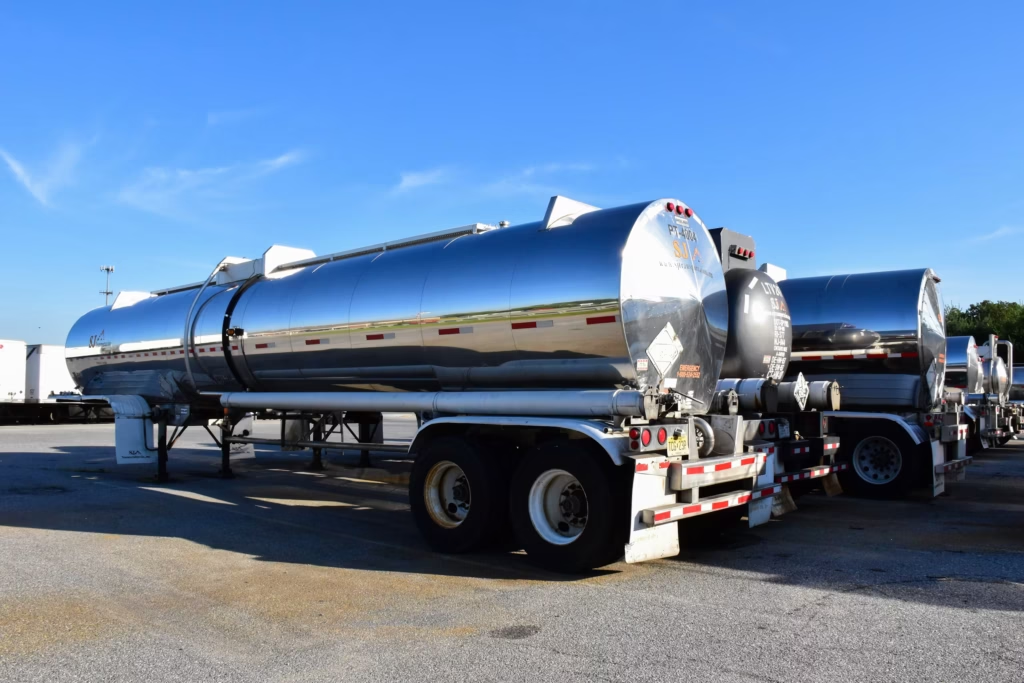
The DOT 407 cargo tank specification (49 CFR 178.347) governs the design and construction of liquid cargo tanks. Under 49 CFR 178.347-2, austenitic stainless steel is one of the approved construction materials for these vessels. As stainless steel resists corrosion, tolerates chemical cleaning agents, and does not retain residue the way other materials can, a tank built to the DOT 407 standard provides the hardware foundation that food-grade operations require.
The procedural layer is built directly upon this hardware foundation under FSMA regulations. Carriers must establish, maintain, and execute written protocols for cleaning, sanitizing when appropriate, and conducting thorough inspections of vehicles and transport equipment. Crucially, these protocols must encompass the entire containment system, including the interior tank walls, valves, fittings, hoses, and connection points, because a pristine tank interior offers no protection if its auxiliary fittings are compromised.
Tank Cleaning Documentation and Wash Records
Records must be retained for a minimum of 12 months and made available to the FDA upon request. The FDA’s Guidance for Industry on Sanitary Transportation of Food identifies failure to maintain tanker wash records as a significant compliance problem.
Written agreements between carrier and shipper under FSMA define which party is responsible for specific sanitation obligations, including cleaning verification prior to loading. That assignment of responsibility belongs in the agreement, established before the first load moves.
What Wash Records Should Establish
Wash records serve as the documented link between a specific load and the verified state of the equipment at the time of transport. Without them, a shipper has no verifiable basis for a carrier’s sanitation claims.
FSMA specifies that written cleaning procedures must remain on-site during vehicle use and that other records must be retrievable within 24 hours of an FDA request. A carrier that cannot produce documentation on either front is not operating to the standard required by the rule.
The Regulatory Framework: FDA, FSMA, and What It Requires of Carriers
The FSMA Sanitary Transportation of Human and Animal Food rule (21 CFR Part 1, Subpart O) establishes binding requirements for vehicles and transportation equipment, operational practices, training, and records, with obligations assigned to both carriers and shippers.
In addition to the shared-responsibility framework, in which shippers and carriers execute written agreements outlining specific sanitary duties, several key regulatory compliance factors must be evaluated.
First, equipment compliance relies heavily on the DOT 407 cargo tank baseline, which serves as the foundation for all sanitation protocols. A trailer failing to meet these physical hardware standards cannot achieve food-grade compliance through cleaning procedures alone. Equipment standards and sanitation procedures must work in tandem to establish whether an operation satisfies food-grade transportation requirements.
Second, FSMA outlines clear training mandates for carriers. Personnel involved in food handling must undergo documented instruction covering basic sanitary protocols, food safety hazards, and regulatory duties. These training records must be formally maintained and available for inspection.
How Shippers Can Evaluate a Carrier’s Contamination Control Practices
Before committing to a carrier, shippers have specific, regulation-grounded questions they can ask and documentation they can request.
- Request the carrier’s written cleaning and sanitation procedures. FSMA requires carriers to maintain these on file. A carrier that cannot produce them is not operating in compliance with the rule.
- Ask about the prior load history for the specific trailers being assigned and whether the equipment is dedicated to food-grade loads. FDA guidance identifies backhauling incompatible materials as a documented contamination pathway. If a carrier cannot account for what the equipment last carried, that is a gap in contamination accountability.
- Confirm that a written sanitary transportation agreement is in place between the carrier and shipper.
- Verify that driver training records exist and cover food safety practices and sanitation responsibilities as required by the rule.
Each of these questions corresponds to a requirement the regulation places on carriers. A carrier that cannot answer them clearly is not operating at the standard the rule defines.
When Protocols Are the Product
Contamination control under FSMA functions as a comprehensive, documented framework. By integrating written protocols, rigorous equipment standards, up-to-date training records, and clear legal agreements, this approach establishes accountability at every stage of the transportation process.
By fully understanding these regulatory expectations, shippers can effectively audit carriers, enforce compliance standards, and demand total visibility into equipment specifications, cleaning procedures, and operational records before tendering their first load.
To support these compliance demands, Tank Carrier Services maintains a fleet of 125 DOT 407 stainless steel trailers backed by strict, FSMA-aligned sanitation protocols. As part of a standard carrier qualification process, shippers can readily request and review documentation covering cleaning histories, previous loads, and driver training records.
25 Gormley Industrial Ave Gormley
ON, L0H 1G0, CANADA
1-844-988-2930
info@tankcarrierservices.com
Copyright © 2026 All rights reserved.
25 Gormley Industrial Ave Gormley
ON, L0H 1G0, CANADA
1-844-988-2930
info@tankcarrierservices.com
Copyright © 2026 All rights reserved.