DOT 407 Tank Trailers: What They Are and Why They Matter for Bulk Liquid Transport
When selecting a carrier for chemical or food-grade liquids, equipment specification is one of the most consequential decisions a shipper can make. The DOT 407 tank trailer is the industry standard for this type of haul, and understanding what that designation actually means, in terms of construction, certification, and ongoing compliance, gives shippers a clearer basis for evaluating carrier quality.
This post covers what defines a DOT 407 tank trailer, the federal regulations that govern it, and what inspection requirements carriers must meet to keep these units in service.
What Defines a DOT 407 Tank Trailer
A DOT 407 tank trailer is a cargo tank motor vehicle built to the specification established under 49 CFR Part 178, Subpart J, specifically §178.347. This spec was developed as the successor to the older MC 307 standard, which some fleet managers still reference. Trailers originally built to the MC 307 spec may continue in service under certain conditions, but new construction must conform to the DOT 407 requirements.
Per §178.347-1, the construction requirements specify a shell made of stainless steel or aluminum with a circular cross-section and a maximum allowable working pressure (MAWP) of at least 25 psig. Minimum shell and head thickness is determined by tank capacity and the material of construction, as set out in the tables under §178.347-2. Tanks with a MAWP exceeding 35 psig must also be designed and certified in conformance with ASME Code Section VIII, which governs unfired pressure vessels.
Capacity varies depending on configuration and the commodity being hauled. A standard DOT 407 trailer typically holds between 5,000 and 7,000 gallons, though exact sizing depends on the density of the product and the axle weight limits applicable to the route.
Why Stainless Steel Construction Matters
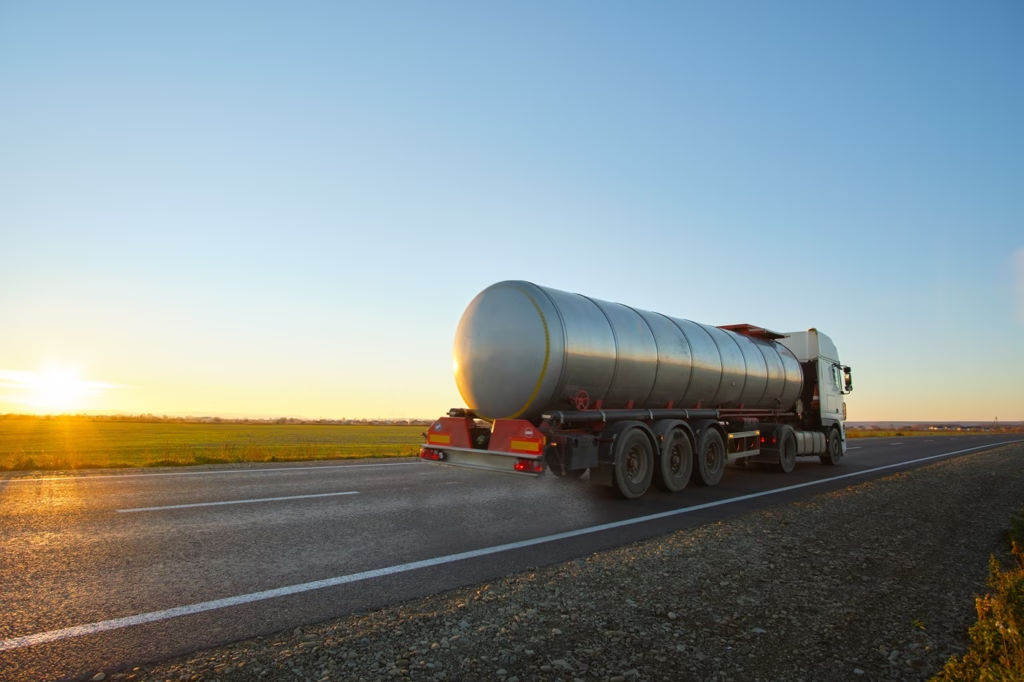
Most DOT 407 trailers in active chemical and food-grade service are built from stainless steel, and the material choice has direct operational implications. Stainless steel is highly resistant to corrosion and chemically inert across a wide range of lading types, which matters when hauling acids, solvents, or food-grade products where contamination risk cannot be tolerated. It also supports the sanitation standards required for food-grade compliance: stainless steel surfaces can withstand the cleaning agents and temperatures necessary to meet those protocols.
Durability is the other factor. Stainless steel tanks hold up over extended service life when properly maintained, which supports a more predictable maintenance and inspection schedule for carriers operating at scale. At Tank Carrier Services, our fleet of 125 DOT 407 stainless steel trailers is maintained to these standards across every unit.
Regulatory Requirements Under 49 CFR Part 178
The federal framework governing DOT 407 tank trailer design and manufacture is established under 49 CFR Part 178, Subpart J. This subpart defines the design, materials, testing, and marking requirements that a trailer must meet at the time of manufacture to carry the DOT 407 designation.
At manufacture, a trailer built to DOT 407 spec must pass burst pressure testing and weld inspection, and must be marked with a specification plate confirming compliance. This plate is the baseline documentation that carriers and shippers rely on to confirm that a given unit was built to spec. The certification is issued by the manufacturer and, once a trailer leaves the factory with that plate, the ongoing obligation to maintain compliance shifts to the carrier.
Design requirements under §178.347 cover the shell, heads, and all structural components. Testing requirements verify that the tank can safely contain its rated pressure under working conditions. Beyond paperwork, these requirements establish the physical tolerances that determine whether a DOT 407 trailer is appropriate for the loads it carries.
Inspection and Recertification Requirements
Certification at the time of manufacture is only the starting point. Carriers are required to maintain ongoing compliance under 49 CFR Part 180, Subpart E, which governs the testing and inspection of specification cargo tanks in service.
Under §180.407, the required inspection types include external visual inspection, internal visual inspection, pressure test, leakage test, and thickness test. The intervals vary by inspection type and tank configuration:
- External visual inspection and leakage test are required annually for most cargo tanks.
- Internal visual inspection is required annually for insulated tanks and for any tank carrying lading corrosive to the tank material. For all other DOT 407 tanks, the interval is every five years.
- Pressure testing follows the same logic: annually for insulated tanks with no manhole, and every five years for all other cargo tanks.
- Thickness testing applies to unlined tanks carrying lading corrosive to the tank material, at least every 2 years. It is not a universal periodic requirement for all DOT 407 tanks. This is clarified in PHMSA interpretation letters from 2004 and 2009, which confirm that thickness testing obligations depend on the nature of the lading and the tank’s construction.
When a trailer fails an inspection or falls out of certification, it cannot be returned to service until the deficiency is corrected and the relevant test is passed. For carriers operating at any meaningful scale, that creates a direct service continuity risk if inspection schedules are not actively managed. Shippers relying on consistent capacity should consider how a prospective carrier handles inspection scheduling and what its out-of-service rate looks like.
How Equipment Specification Affects Carrier Selection
A carrier operating non-compliant or poorly maintained equipment creates contamination risk, liability exposure, and the potential for service failures at the worst possible time.
Verifying that a carrier’s fleet is built to DOT 407 spec is a reasonable starting point, but it does not tell the whole story. Two carriers can both operate DOT 407 trailers and still differ significantly in how well those units are maintained. Inspection history, out-of-service frequency, cleaning protocols, and fleet age all affect the practical reliability of the equipment on any given load.
Questions worth asking a prospective carrier include: What percentage of your fleet is DOT 407 certified? How do you track inspection intervals and certification status? What is your average time-to-return for a trailer that requires repair? These are operational questions, not compliance checkboxes, and they tend to separate carriers who manage their fleets proactively from those who manage reactively.
Specification Is a Service Standard
DOT 407 spec defines a construction and compliance floor. What a carrier does above that floor, in terms of maintenance discipline, inspection rigor, and fleet management, determines the actual level of service a shipper receives.
Equipment condition and inspection history are legitimate evaluation criteria. Shippers who understand what DOT 407 compliance actually requires are better positioned to ask the right questions and assess the answers accurately. The spec tells you what a trailer was built to and the carrier’s maintenance record tells you what condition it is in today.
At Tank Carrier Services, our bulk liquid transportation operations are built around a fleet of 125 DOT 407 stainless steel trailers maintained to consistent inspection and service standards. If you want to discuss how our equipment and compliance practices align with your shipping requirements, contact our team.
25 Gormley Industrial Ave Gormley
ON, L0H 1G0, CANADA
1-844-988-2930
info@tankcarrierservices.com
Copyright © 2026 All rights reserved.
25 Gormley Industrial Ave Gormley
ON, L0H 1G0, CANADA
1-844-988-2930
info@tankcarrierservices.com
Copyright © 2026 All rights reserved.